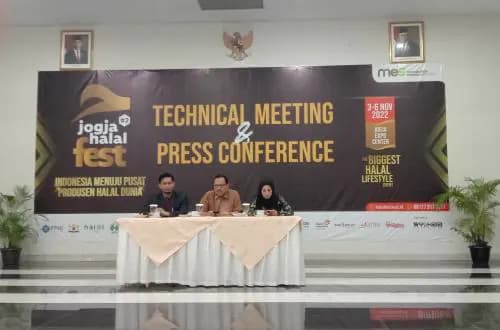
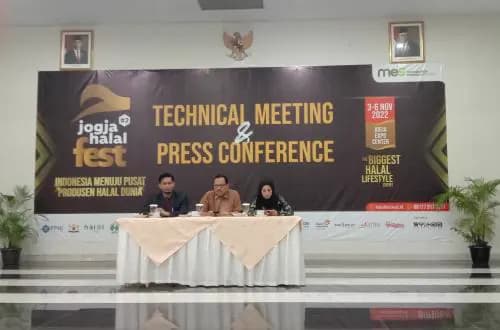
Vice President K.H. Ma'ruf Amin opened the 2nd Jogja Halal Fest online on November 3 2022. In his speech, he placed Yogyakarta as an area with great potential in culinary, batik fashion, crafts and various creative industry products that can enter the halal value chain.
This potential still faces business readiness challenges. A release from the Vice President's Secretariat stated that data from the DIY Cooperatives and SMEs Service at that time recorded more than 300 thousand SMEs, while around 0.1 percent had been certified halal. This gap shows that promotion needs to go hand in hand with assistance, financing and strengthening standards.
Collaboration between large businesses and SMEs, access to sharia financing, mobilization of sharia social funds, and strengthening sharia economic institutions in the regions.
The first strategy is to strengthen collaboration so that large businesses can help SMEs develop capacity and reach global markets. Collaboration is needed because quality-ready products do not necessarily have a distribution network, buyer information, or the ability to meet large volume demand.
The second strategy emphasizes access to sharia financial services. Financing is required for equipment, raw materials, certification, packaging development, and working capital. Without easy access, business actors will have difficulty following up on opportunities that arise from exhibitions or business matching.
The third strategy is to mobilize zakat, infaq, alms and waqf productively. Social funds can support the empowerment of micro actors, training and programs that expand equality of welfare.
The fourth strategy encourages the formation of a Sharia Economic and Financial Regional Committee in DIY. This institution is expected to be a link between the national agenda and regional potential, while maintaining coordination across government, regulators, industry, academia and the community.
With this context, JHF #2 is not just a promotional stage. The festival is a place to bring together actors who hold different parts of the ecosystem: producers, buyers, financing institutions, certification partners, government, and society as consumers.